
“Far from the job market” is an expression often used in statistics, reports and public debate. It sounds neutral, almost technical. But behind the wording are people with completely different lives, experiences and circumstances.
Being far from the labour market is rarely about unwillingness. It is often about the path to work becoming difficult to see or that previous attempts have led to setbacks.
In this article, we delve into what the concept means in practice, and why the path forward needs to look different for different people.
What does “far from the job market” actually mean?
The term is used to describe people who have difficulty getting or keeping a job, but it says very little about why.
In practice, the distance to the labor market can depend on many different things.
- long-term illness or mental illness
- long absence from work
- lack of previous work experience
- social or economic vulnerability
The commonality is not the cause but that work right now is not possible without support, adaptation or time.
The distance is often greater than it seems
When people talk about being far from the labor market, it sounds like a distance from a job. In reality, it is often a greater distance than that.
It could be about:
- lack of everyday structure
- low confidence in one’s own abilities
- concerns about finances and livelihoods
- previous negative experiences with government contacts
- fear of failing again
When several such factors coincide, even small demands can be perceived as large. This is why general solutions rarely work for everyone.
Why aren't demands or an increase in pace enough?
In public debate, there is often a perception that clearer requirements or economic pressure automatically leads to work. Experience from practice shows otherwise.
För personer som redan befinner sig i en utsatt situation kan hårdare krav i stället:
- increase stress and anxiety
- aggravate ill health
- lead to the suspension of operations
Development does not fail because there is no will – but because the conditions are not right.
How do you reduce the distance in practice?
Approaching the labor market is rarely a straightforward journey. For many, it starts not with a job, but with stability.
It can be about that:
- create routines in everyday life
- participate in work-like settings without full pressure to perform
- receive support over time, rather than one-off interventions
- gradually build confidence and work skills
For some, this leads to work. For others, to studies, rehabilitation or other sustainable steps forward.
What does it look like in reality?
In the daily work at AKG Sweden, we meet people whose distance to the labor market cannot be measured in months or years. For some, the step forward is about managing a few hours a week in a calm context. For others, it is about daring to believe in their own abilities again. For many, it is about first creating security before the next step is possible. The path to work rarely looks the same. And it is almost never straight.
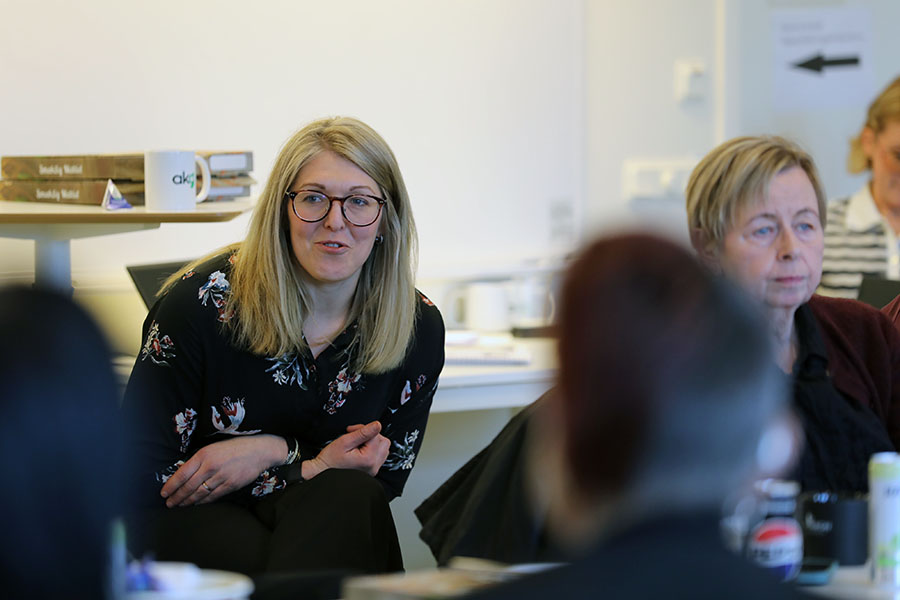
In her work as a specialist in Individual Pedagogical Support in Education (IPSU), Erica meets people who are often far from the job market.
“Many of the people I meet have the will, but lack the conditions. It’s not the studies or work that are difficult in themselves, it’s getting there without security, structure and trust. When we start there, things happen.”
– Erica Hodin, IPSU specialist at AKG
Work as a goal – but not as a shortcut
Work can be an important part of participation, identity and independence. At the same time, work is not always the first step. When the focus is solely on the end goal, you risk missing out on what makes development possible: security, time and reasonable conditions.
Reducing the distance to the labor market is therefore not about rushing, but about creating sustainable paths forward. Being far from the labor market is not a condition that looks the same for everyone. It is a collective term for different life situations where work is not possible right now but where development is still possible.
When interventions are based on the individual’s reality, rather than on general templates, the conditions for long-term results increase – for both the individual and society.
Related questions
What counts as being far from the labor market?
Being distant from the labor market means that a person finds it difficult to get or keep a job for a long time. This may be due to ill health, long absence from work or similar, lack of work experience or social vulnerability. The term describes a distance to work – not a lack of will.
How does long absence affect the ability to return to work?
Long absences from work can affect both work ability and self-confidence. Routines may have disappeared and the threshold to return can feel high. At the same time, return is possible, especially when the steps are adapted to the individual’s circumstances.
What support is available for people far from the labor market?
There are various forms of support, often in collaboration between authorities and professional actors. The support can involve work-oriented rehabilitation, education, training, job coaching or individually adapted measures over time.
How long does it take to get closer to the labor market?
There is no general timeframe. For some, progress is rapid, for others it takes longer. The length of the process depends on the individual’s life situation, health and the support available around them
What is the first step back to work for many people?
For many, the first step is not about work per se, but about creating stability in everyday life. It can be about building routines, participating in aa context oror gradually approaching working life without full pressure to perform.
Is it possible to be far from the labor market despite motivation to work?
Yes, it is. Motivation is important, but often not enough. Even people who want to work can be far from the labor market if the conditions are not right, for example due to ill health or previous negative experiences.

Anna Thofelt
anna.thofelt@akgsverige.se